Fabric Width and Railroading, Explained
Most decorator fabric is 54 inches wide, which is narrower than a lot of windows. That single number is why wide curtains have seams, why you cut several widths and join them, and why railroaded fabric exists at all. You join widths side by side to make a curtain wider than the cloth, and railroading turns the fabric sideways to skip the seams. Both decisions change how much fabric you buy.
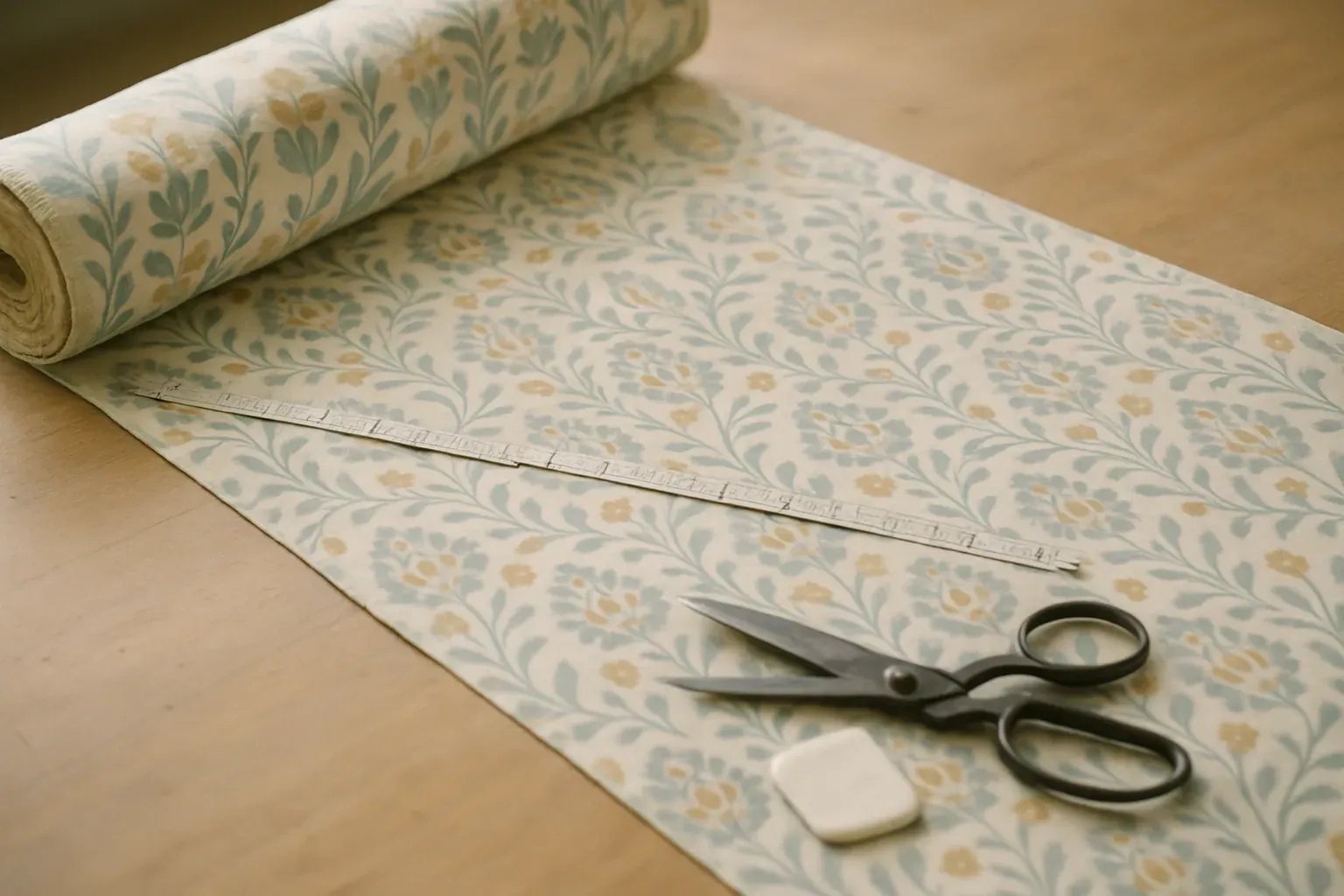
How wide is curtain fabric?
Most decorator and curtain fabric is 54 inches wide, about 137 cm, and has been for a long time. The number is not random. The story usually told in the trade is that 54 inches matched the width of a horse-drawn delivery cart, so cloth was woven to fit, and the standard stuck long after the carts went. Whatever the history, 54 inches is the figure on most rolls you will buy today.
You will meet two other widths. Narrow 44 to 45 inch fabric is common in quilting and apparel cottons, fine for small curtains but rarely ideal for big ones. And wide-width curtain fabric, often 280 to 300 cm, is woven on purpose so a tall curtain can be made without a horizontal seam. The width is always listed, and it is the first number to check, because it decides how many pieces you cut.
Why do wide curtains have seams?
Because the curtain is wider than the cloth. Once you add fullness, the gathered width of a curtain is usually a lot more than 54 inches, so you cannot cut it from a single run of standard fabric. Instead you cut several lengths, called widths, and sew them edge to edge to build each curtain to size. Every join between two widths is a vertical seam.
A good workroom hides those seams. The widths are positioned so the seams fall back in the folds of the gathered heading, where the eye does not catch them, and a half-width is often placed at the outer edge so the leading edge stays clean. On a patterned fabric there is an extra rule: the pattern has to match across every seam, which is why patterned curtains use more cloth. The matching is covered in pattern repeat explained.
What does railroading do?
Railroading turns the fabric on its side so a wide curtain can skip the vertical seams. A railroaded fabric is made with its pattern running along the length of the roll instead of up it, so you can rotate the cloth ninety degrees. The width of the roll becomes the height of the curtain, and the length you unroll becomes the curtain's width. Unroll more and the curtain gets wider, with no seams, because it is all one piece.
It is the trick behind wide runs with no vertical seams: a long wall of curtains, a wide roman blind, the back of a banquette seat. The limit is the drop. Railroading only works if your finished drop, plus the header and hem, fits within the roll width. A 280 cm wide fabric gives a seam-free drop of roughly 264 cm once you take off the turnings. Taller than that and the drop will not fit across the roll, so you are back to joining widths the normal way.
How width feeds the fabric calculation
The usable fabric width is one of the core inputs to any curtain fabric sum. You take the track width, multiply by the fullness for your heading, then divide by the usable width to get the number of widths to cut. A narrower fabric means more widths and more seams, a wider one means fewer. Get the width wrong by an inch and the whole order can be off by a full width.
The curtain fabric calculator asks for the fabric width and does the division for you, in inches or metric, then prints how many widths to cut and the length of each. Set the width from the actual roll, not a guess. For the measuring that comes first, see how to measure for curtains, choose a heading in the fullness and pleat guide, and if you are lining the curtains, the lining guide explains how the second cloth fits in.
Set your fabric width and count the widths
Enter the roll width and get the number of widths to cut, with seams placed for you.