How Much Fabric for Bay Window Curtains
A bay window is really three or more windows that meet at an angle, so you measure and cost each section on its own, then add them up. Treat it as one flat window and the curtains will not sit right across the angles. Measure each section, size its widths on its own fullness, add them up, then allow about 10 to 15 percent extra for the angles. That is the whole job.
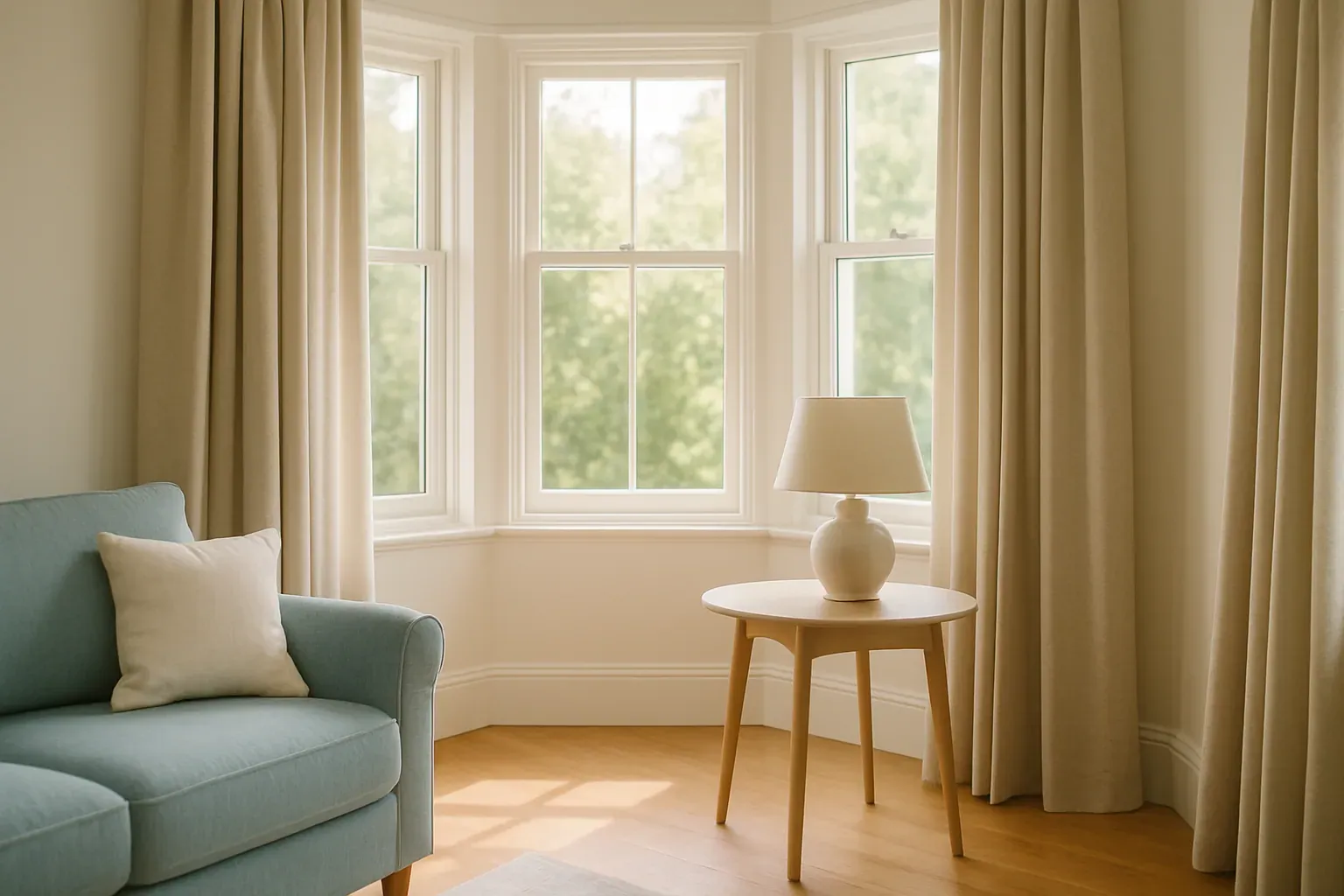
Why you measure a bay section by section
A bay is several windows that meet at an angle, so you treat each flat section as its own little window and add the results. The reason is geometry. Run a tape straight across the front of a bay and you get the opening, which is smaller than the curtain track that hugs the wall around the inside. The track is longer, and the track length is what your fabric pays for. Measure around the angles, not across the gap.
So a typical three-sided bay gives you three widths: the back wall and the two angled returns. Write all three down. You will size the fabric for each section, then total them, rather than working off one flat number that hides the angles. This is the single mistake that leaves a bay short of cloth.
How to calculate bay window curtain fabric
Once you have the section widths, the sum is the same one you would do for any window, just repeated per section and totalled. Here is the order:
- Measure the track or pole along each straight section of the bay separately, following the angles. Note each width on its own.
- For each section, multiply its width by the fullness for your heading, then divide by the usable fabric width to get the number of widths, rounded up.
- Add the section widths together for the total number of widths across the whole bay.
- Cut every width to the finished drop plus header and hem, rounded up to a whole pattern repeat if the fabric is patterned.
- Add a waste allowance, around 10 to 15 percent on a bay, because the angled returns and any joins eat more cloth than a flat window.
The waste allowance is the part people skip. A bay has extra joins where widths meet, returns that wrap into the wall, and angled cuts, and all of that turns into offcuts. Around 10 to 15 percent on top of the flat calculation covers it. On a patterned fabric, leave the higher end, because every section still rounds up to a whole pattern repeat and the rounding stacks across sections.
How many curtains does a bay window need?
That depends on how you want them to draw and stack. The common layout is a pair that meets in the centre of the back section and pulls back into the two corners, which keeps the glass clear and the bay feeling open. Wide or deep bays often use more panels, one per section or a panel at each break, so each one can stack neatly out of the light rather than bunching on an angle. Bay window poles and tracks are made to bend around the corners so a single curtain can run the whole bay if you prefer.
Settle the panel layout before you buy, because it changes the count of leading edges and returns, and each of those needs its own fabric and finishing. More panels mean more side hems and more handling allowance, which is part of why a bay costs a little more per metre of window than a flat wall.
Run your bay through the calculator
Do the section sums by hand if you like, but the curtain fabric calculator is quicker for a bay. Run each section as its own calculation, in inches or metric, note the widths and total fabric for each, then add them up and apply your waste allowance. The cut list it prints gives you the exact cut length per width, with the pattern repeat already added, so the workroom can cut every section without re-doing the maths.
Before you start, get the basics down with how to measure for curtains, pick a heading in the fullness and pleat guide, and if your fabric has a design, read pattern repeat explained so the repeat across the bay lines up.
Size each section of your bay
Run a calculation per section, then total the widths and add your waste allowance.